Height, hormones, human ambitions
High Peak Peptides starts with childhood height
Sermorelin helped children with growth hormone deficiency grow faster. For me, centimetres offer a better starting point than promises about adult vitality.

Childhood growth
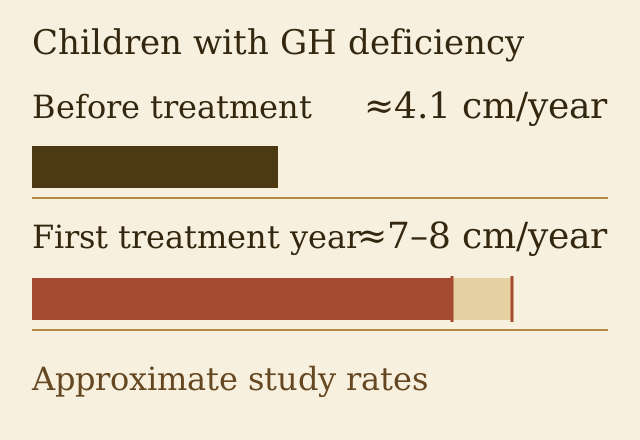
In a 1996 trial of prepubertal children with growth hormone deficiency, sermorelin accelerated height growth during the first treatment year. The rate rose from about 4.1 cm/year to roughly 7–8 cm/year, without excessive generation of IGF-1, the growth-related protein that responds to growth hormone.
I’m rather fond of this literal meaning of growth. A child’s height over a year has a physical scale, a defined population and an understandable purpose. The result gives sermorelin a substantial history before any discussion of feeling younger begins.
It also gives the word “high” some useful discipline. The desirable change in this experiment was faster growth in children who lacked enough growth hormone. Carrying that success into a conversation about adult energy or recovery requires another experiment, with a different purpose. I’d take those particular centimetres over a slogan about raising a blood number.
Longer bones in rats
Ipamorelin has a skeletal story too. In adult female rats, longitudinal bone growth increased, while total circulating IGF-1 and the other reported bone markers did not change. A result in a bone can be more interesting than the familiar blood test beside it.
That finding unsettles the tidy account in which everything follows one hormone reading. I’d give the rat experiment room on the page precisely because it complicates that account. Its population remains adult female rats; it supplies no evidence that adult people become taller or recover faster.
The ipamorelin essay follows the animal work into weight loss during chemotherapy and then into the human bowel-surgery trial. The studies have quite different ideas of a desirable change.
The adult argument
For adult sermorelin, the argument becomes less settled. Walker’s editorial case for preserving the body’s pulsatile hormone release is appealing physiology. Blackman’s caution about using secretagogues against aging challenges how far that appeal can carry a treatment claim. Both are editorials. Adult outcomes win my vote, and the physiological argument still deserves consideration.
CJC-1295 adds an ingenious chemical achievement: prolonged GH and IGF-1 elevation in healthy adults. Longer exposure then becomes another thing to explain and investigate. The human studies leave sleep, strength and long-term safety open.
Start with sermorelin and growth hormone for the childhood history and laboratory questions, or use the comparison to see which outcomes each compound actually reached. The word growth has acquired several ambitions. Some have firmer measurements than others.